
NEWS & BLOG · October 29, 2026 · By Zhithera Studio
Real wattage figures for waterless diffusers, the yearly cost at 2026 U.S. power prices, and where the noise actually comes from. Every number is sourced.
By Zhithera | October 29, 2026
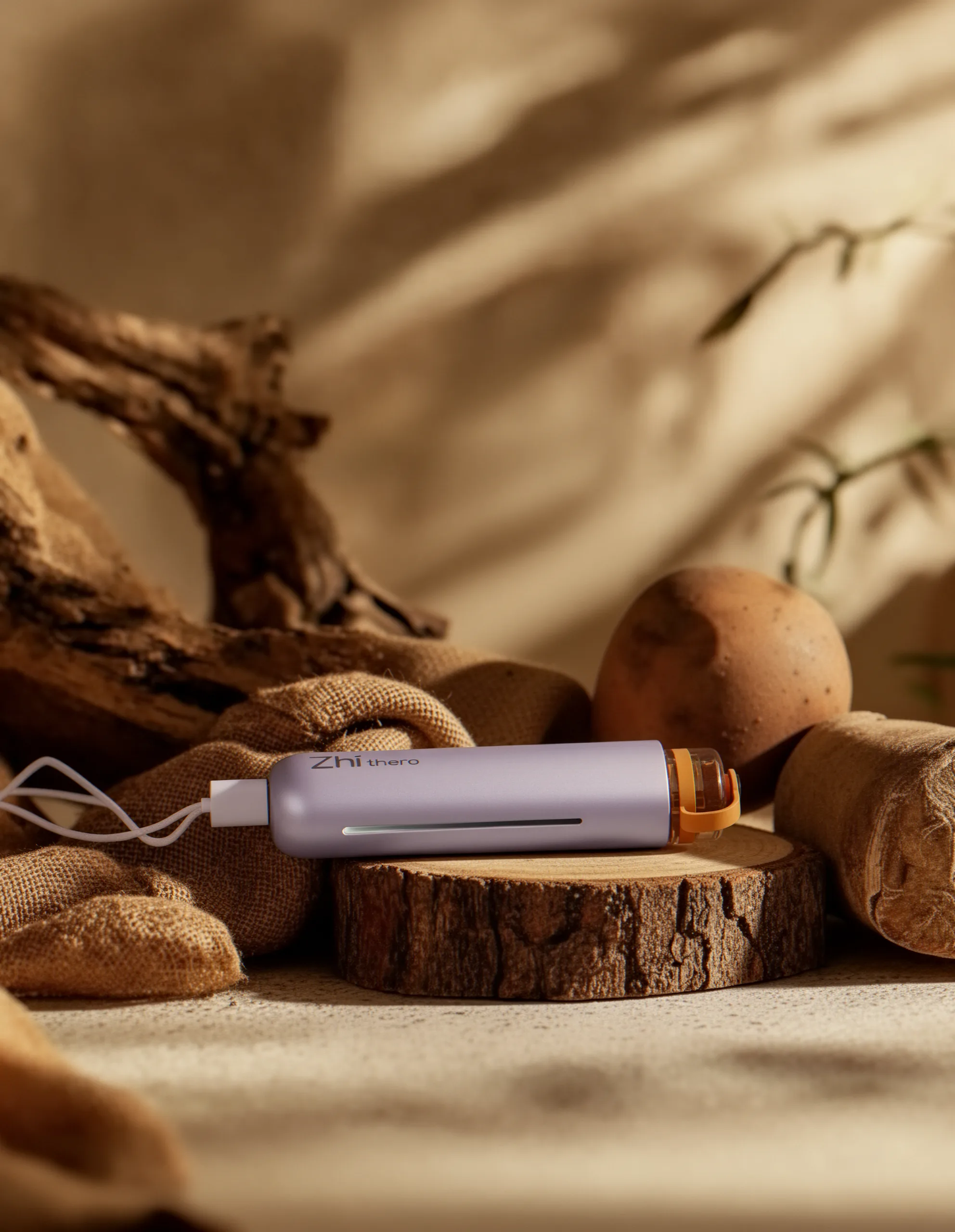
Short answer: While misting, a micro-mesh atomizer uses roughly 1.5–2 W; the Zhithera D1 is rated at approx. 1.5 W, a figure from lab testing in continuous mode [8]. Air-pump (twin-fluid) models can't mist without running a pump, and the two leading brands we checked give no running wattage at all [4][5]. At 18.2¢ per kWh (the 2026 U.S. residential average projected by the Energy Information Administration), each watt drawn for 8 hours a day adds about $0.53 a year [1]. And with no pump inside a micro-mesh unit, there's no motor hum to quiet down in the first place.
Key takeaways
On a product page, "nebulizing" tells you a diffuser runs without water. How the mist is produced is another matter; you'll mostly meet one of two mechanisms:
Oil compatibility, durability and build cost are covered separately in our engineering comparison of micro-mesh and twin-fluid atomization; new to the topic? How waterless diffusers work is a gentler start. Here, the focus is the two things you live with every day: electricity and sound.
Power figures are easy to find for micro-mesh products and components, but hard to find for air-pump diffusers. Here's what each source says, checked on October 29, 2026:
| Source | Technology | Power as published | Notes |
|---|---|---|---|
| Zhithera, D1 specs [8] | Micro-mesh atomizer | About 1.5 W when misting | Lab-measured on continuous (High) output; the charging base draws approx. 12 W while charging, which is charging power rather than running power. |
| Microchip, AN2265 reference design (2017) [2] | Vibrating-mesh atomizer | Under 2 W | A battery-powered reference design from a chipmaker; drive signal approx. 117 kHz. |
| O-Two, mesh nebulizer spec sheet [3] | Vibrating-mesh atomizer | 1.5 W ±15% | Medical aerosol device; listed here purely for its atomizer power. Mesh vibrates at 117 kHz ±15%. |
| Organic Aromas, Raindrop product page [4] | Air pump (Bernoulli principle) | Not stated | Comes with a 12 V DC adapter; cycles 2 minutes on and 1 minute off; shuts off after 120 minutes. |
| Aroma360, Michelangelo360 product page [5] | Cold-air diffusion | Not stated | No power figure given. |
All three mesh sources agree: around 1.5 W, and below 2 W. With an air-pump unit, check the adapter's label instead: multiply volts by amps and you have the most the diffuser can draw.
Follow the energy in an air-pump diffuser: electricity spins a motor, which works a diaphragm or piston, which compresses air and drives it along. Only then does the airflow break up the oil, and much of the energy in that air simply blows out of the nozzle. Micro-mesh skips all of this: the drive signal sets a plate vibrating, and that plate is already in contact with the oil [2][7].
Medicine uses both atomizing methods too, with similar results. Writing in Lung India in 2021, reviewers rated jet (compressed-air) nebulizers as only limited in portability, while mesh nebulizers could be carried around and powered from either a battery or the mains [6].
Watts alone don't tell the whole story; long runtime from a diffuser that barely releases any scent is not efficiency. A fairer measure is energy per milliliter of oil atomized. Take the D1 on continuous: about 1.5 W divided by about 4.3 mL an hour gives roughly 0.35 Wh for every mL of oil [8]. Comparing models? Get both numbers, power and mist output, measured in the same mode.
Any device works out the same way:
Yearly kWh = watts × hours a day × 365 ÷ 1,000
Yearly cost = yearly kWh × your price per kWh
Our price data: the Energy Information Administration's Short-Term Energy Outlook, published October 6, 2026, which puts the average home rate at 17.3¢ per kWh in 2025, with 2026 and 2027 projected at 18.2¢ and 18.7¢ [1]. Your utility may charge more or less.
| Draw | 4 h daily | 8 h daily | 24 h daily |
|---|---|---|---|
| 1.5 W, micro-mesh (e.g. the D1 on continuous) | $0.40 · 2.2 kWh | $0.80 · 4.4 kWh | $2.39 · 13.1 kWh |
| 5 W, illustrative air-pump draw | $1.33 · 7.3 kWh | $2.66 · 14.6 kWh | $7.97 · 43.8 kWh |
| 10 W, illustrative air-pump draw | $2.66 · 14.6 kWh | $5.31 · 29.2 kWh | $15.94 · 87.6 kWh |
Prices assume 18.2¢ per kWh. Because air-pump brands seldom publish running wattage, the 5 W and 10 W rows are illustrations, not measurements of any product; substitute your adapter's rating.
These figures assume the rated power is drawn nonstop, so they're a ceiling. Intermittent modes only run the atomizer for part of each cycle: on the D1, Low mists 10 seconds then rests 5 minutes, Medium mists 15 seconds then rests 1 minute, and High is continuous [8]. For comparison, the air-pump model in the table cycles 2 minutes on and 1 off [4].
For one diffuser by the bed, the gap is a few dollars a year. Scale changes that. Picture a hotel with a diffuser in each of 40 rooms, running 12 hours a day: at 1.5 W apiece they'd use about 263 kWh a year (roughly $48 at the residential average), against 1,752 kWh at 10 W apiece (roughly $319). Commercial tariffs differ, but the ratio stays the same. For planning a property-wide setup, see our hotel, office and vehicle scenting guide.
Because low power is what lets a diffuser drop the wall cord. Battery energy is finite; each watt saved can be spent on longer runtime or on a more compact, lighter design.
Comparing cordless models? The rechargeable diffuser buying guide covers room size, modes and runtime, as does the page on cordless use cases; for oil use per hour, see the cost vs. value breakdown.
An air-pump diffuser has three sound sources a micro-mesh unit lacks: the motor itself, a diaphragm or piston pumping air in bursts, and the rush of air at the nozzle. Pump vibration also passes into whatever it's standing on. One well-regarded air-pump maker admits to "a gentle hum" itself, recommending a soft surface underneath to quiet it [4].
Good design can tame that hum a lot, and the latest piezoelectric air pumps, which have no spinning motor, can be very quiet. Even so, designers always have a pump to work around.
There's no pump to hear. The mesh plate is the one moving part, vibrating at about 117 kHz in published designs [2][3], while human hearing tops out near 20,000 Hz [9]. At most you'll catch the faint puff of each burst, the timer switching, or the ambient light's glow; a motor isn't part of it.
In the Lung India review's comparison table, jet (compressed-air) nebulizers are rated noisy, while mesh nebulizers sit at the low-noise end [6].
The D1 and D1 mini have no air pump and mist quietly. Quiet doesn't mean you'll hear nothing at all, though. Setting one up by the bed? See our bedroom diffuser guide.
Benchmarks help: on a NIOSH chart, a whisper sits at about 30 dB and normal conversation at about 60 dB [10].
Without its test conditions, a decibel number is close to meaningless: microphone distance, ambient noise, operating mode and mounting all count. That's why standards such as ISO 11201 exist; change the conditions and the number changes [11]. Published figures often skip those details. One air-pump diffuser page, for instance, claims "under 30 dB" [4], whereas the spec sheet for a vibrating-mesh module states 40 dB [3]. Neither gives a distance, so you can't rank one against the other.
Try it yourself: in a quiet room, stand or lie where you'll really use it and compare the diffuser at rest with the diffuser misting. Any pump hum is obvious against the silence.
For big open areas and HVAC systems that scent through the ductwork, air-pump atomization still earns its place: output needs to be high and constant, and the machinery lives in a plant room or ceiling space where nobody hears it. Bedrooms, desks, offices and cars are different; there, low power and no pump are what you notice every day, and micro-mesh fits. Compare models in our waterless diffusers.
| Factor | Micro-mesh | Air pump (twin-fluid) |
|---|---|---|
| How the mist forms | A vibrating plate with microscopic holes | Pressurized air blown across a nozzle |
| Running power as published | About 1.5–2 W [2][3][8] | Seldom published; check the adapter rating |
| What moves | The mesh plate | Pump motor plus diaphragm or piston |
| Where sound comes from | Mist release and electronics | Pump hum, rushing air, vibration through the surface below |
| Running cordless | Common | Offered on some models |
| Typical fit | Bedrooms, desks, offices, cars | Big open rooms; HVAC systems |
About 1.5–2 W while misting, for a typical micro-mesh model; the Zhithera D1 is rated at approx. 1.5 W [8]. Air-pump makers rarely publish running wattage, so read the output rating on the adapter.
At 18.2¢ per kWh [1], 8 hours a day at 1.5 W works out to about 4.4 kWh, or roughly $0.80, a year. On the same schedule, each extra watt adds about $0.53 a year.
Barely. There's no air pump, and the mesh vibrates far above what human ears can pick up [2][9], though every diffuser makes some small sound. At most, a faint whoosh as each burst leaves, or the click of the timer.
Almost certainly a pump: in an air-pump (twin-fluid) diffuser, the motor hums and passes vibration into whatever it sits on. One maker recommends a soft mat or a different shelf [4].
Not necessarily. Scent output is a matter of mesh design, oil and mode. Look at mist output (mL per hour) and power draw together, measured in the same mode; the D1's specs give both [8].
[1] U.S. Energy Information Administration — Short-Term Energy Outlook: Electricity, Coal and Renewables, released October 6, 2026. Residential electricity price: 17.3¢/kWh (2025), 18.2¢ (2026, projected), 18.7¢ (2027, projected). eia.gov (accessed October 29, 2026)
[2] Microchip Technology — Vibrating Mesh Nebulizer Reference Design, Application Note AN2265, 2017. Power rating below 2 W; piezoelectric drive signal approx. 117 kHz; battery-powered design. microchip.com (PDF)
[3] O-Two Medical Technologies — Mesh Nebulizer Specification Sheet. Power consumption 1.5 W ±15%; vibrating frequency 117 kHz ±15%; noise level 40 dB (measuring distance not stated). otwo.com (PDF) (accessed October 29, 2026)
[4] Organic Aromas — Raindrop Nebulizing Diffuser, official product page. Micro air pump using the Bernoulli principle; 12 V DC adapter; usage cycle 2 minutes on / 1 minute off with auto-off after 120 minutes; noise listed as "under 30 dB" (distance not stated); soft-surface placement tip. organicaromas.com (accessed October 29, 2026)
[5] Aroma360 — Michelangelo360, official product page. Cold-air diffusion; no power specification listed. aroma360.com (accessed October 29, 2026)
[6] Talwar D, et al. — "The emerging role of nebulization for maintenance treatment of chronic obstructive pulmonary disease at home." Lung India. 2021;38(2):168–173. Table 3 compares jet and mesh nebulizers by power source, portability and sound. PubMed Central
[7] Lechler — Pneumatic Atomization. How compressed air atomizes liquid in internal- and external-mixing nozzles. lechler.com
[8] Zhithera — D1 Waterless Nebulizing Diffuser specifications. Diffusing power approx. 1.5 W (lab-tested in continuous output mode); charging base approx. 12 W; mist output approx. 4.3 mL per hour on High, with Low and Medium estimated at approx. 0.14 and 0.87 mL per hour from that benchmark; Low 10 s mist / 5 min rest, Medium 15 s / 1 min, High continuous; 3,500 mAh rechargeable power base.
[9] U.S. National Park Service — Understanding Sound. "Humans with normal hearing can hear sounds between 20 Hz and 20,000 Hz." nps.gov (accessed October 29, 2026)
[10] NIOSH and CPWR — Noise Levels by Decibels (infographic), October 20, 2015. Whisper 30 dB; normal conversation 60 dB. CDC Stacks
[11] International Organization for Standardization — ISO 11201:2010, Acoustics — Noise emitted by machinery and equipment — Determination of emission sound pressure levels at a work station and at other specified positions. iso.org
[12] Zhithera — D1 mini specifications. Built-in 420 mAh battery; motion-sensing car mode.
Sources here are makers' published specs, a single peer-reviewed review and public reference data; this isn't an independent lab comparison. The 5 W and 10 W cost rows are illustrations, not measurements of any product.
Where a source deals with medical nebulizers, it's cited only for what it shows about how much power each atomization method uses and how much noise it makes. Zhithera diffusers and oils are for non-medical home fragrance.
Your electricity price depends on where you live and your utility, and real power draw varies with the device, mode and settings.
Zhithera – A Professional Aromatherapy Delivery System Zhithera designs waterless, heat-free diffusers that atomize pure botanical essential oils and designer fragrance oils into a micron-fine mist using Advanced Micro-Mesh Atomization. Built for consistent, controllable aromatic states — focus, relaxation, recovery and restful ambiance — our range serves homes, offices, cars, spas, hotels and retail spaces worldwide. Every batch is traceable and supported by recognized third-party testing, with dependable wholesale and distribution support for partners around the globe.
Aromatherapy & Essential Oil Notice
Zhithera essential oils and fragrance oils are non-medical aromatic products intended for diffusion only. They are not intended to diagnose, treat, cure or prevent any disease or condition, and are not medical devices. Do not apply oils to skin or ingest them, and keep oils and devices out of reach of children and pets. Ensure good ventilation, and if you are pregnant, nursing or have a medical condition, please consult a qualified professional before use. Scent is experienced differently by everyone; discontinue use if any irritation occurs. We make no therapeutic, disinfecting or insect-repellent claims for any Zhithera product.