


NEWS & BLOG · October 20, 2026 · By Zhithera Studio
Power, noise, which oils work, how hard each design is to build, and what comes next for portable diffusers: an engineering comparison.
By Zhithera | October 20, 2026
Pneumatic atomization has been turning liquids into fine droplets for decades.
You'll find it in industrial spraying, coating lines, humidifiers and fragrance systems. The idea is simple: a stream of pressurized air meets a stream of liquid and tears it into droplets small enough to drift into the surrounding air.
Engineers call this twin-fluid atomization, the two fluids being air and the liquid itself.
It works. But squeezing it into a small consumer device brings trade-offs in power draw, mechanical complexity, vibration and noise.
And home aroma diffusers have different priorities from industrial atomizers.
People now expect a diffuser to be quiet, fit on a shelf or in a car, run on a rechargeable battery, and deliver scent without fussy upkeep.
Those expectations opened the door to a different method: piezoelectric vibrating micro-mesh atomization.
Instead of relying on compressed air to break up the liquid, a micro-mesh uses vibration at ultrasonic frequency and microscopic, precisely made holes.
That's more than a parts swap. It changes the route by which electricity becomes scented mist.
Below, we look at the engineering behind both methods: where micro-mesh has a real edge, and where pneumatic designs still earn their place.
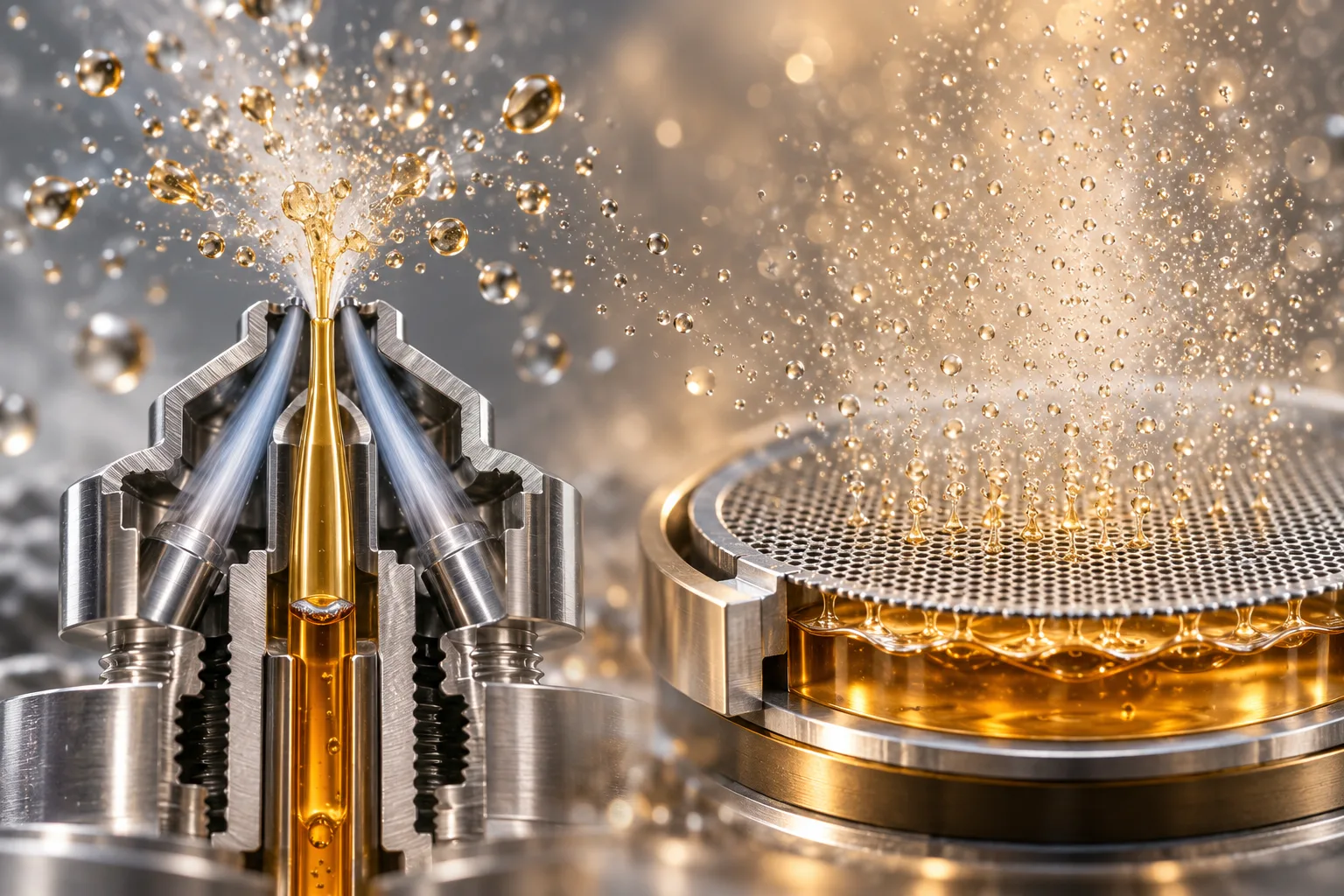
Most self-contained twin-fluid diffusers start with a motor that drives an air pump.
The pump pushes air through a nozzle, where it collides with the fragrance liquid; the mismatch in speed between air and liquid is what tears the liquid into droplets.
Put as an energy chain:
Electricity → Motor-Driven Pump → Pressurized Air → Atomized Liquid
Each link adds parts that depend on one another: potentially a motor, a pump assembly, air passages, a nozzle, a liquid reservoir and control electronics.
Results hinge on pump characteristics, airflow, nozzle geometry, how liquid is supplied and what the fragrance is like physically.
Industrial nozzle manufacturer Lechler distinguishes internal-mixing from external-mixing pneumatic atomizers, each with its own strengths in flow control and in coping with viscous liquids.
Reference: Lechler — Pneumatic Atomization [1].
The mechanism is different from the ground up.
A piezoelectric element turns an electrical drive signal into rapid mechanical vibration, and that vibration moves a thin membrane perforated with precisely formed microscopic holes.
When liquid meets the moving membrane, the vibrating microstructure throws it off as fine droplets.
Its main energy chain is shorter:
Electricity → Piezoelectric Vibration → Mesh Atomization
No compressor is needed to produce the force that breaks up the liquid, which a conventional air-pump design can't avoid.
That makes compact atomizing modules possible with no motor-driven air pump at all.
Microchip Technology's Vibrating Mesh Nebulizer Reference Design describes the same setup: a piezoelectric mesh driven by compact electronics running on batteries.
A study in the journal Electronics also used microporous piezoelectric transducers in an experimental system for generating odors.
References: Microchip AN2265 [2]; Wen et al., Electronics, 2019 [3].
What micro-mesh really changes is how much a diffuser leans on a separate machine for making air.
With fewer pumping parts, the internals can be packaged more simply, there's less pump vibration to manage, and the product can shrink.
Still, the result depends on the quality of the mesh, the driver electronics, how liquid reaches the mesh, and the engineering as a whole.
Micro-mesh isn't a shrunken twin-fluid system.
It moves where, and how, the energy for atomization is applied.
For a portable diffuser, energy use is near the top of the list.
A motor-driven pneumatic diffuser spends part of its electricity running a pump and creating the airflow that atomizes the liquid.
Along the way, some energy can be lost electrically, mechanically and pneumatically before any of it reaches the liquid.
Micro-mesh atomization removes the conventional compressor as the main atomizing mechanism.
Here, electricity powers a piezoelectric element, and its vibration acts on the liquid via the membrane with no air stage in between.
AN2265, Microchip's application note, describes a vibrating mesh nebulizer that runs on batteries.
It specifies a typical piezo drive signal of roughly 117 kHz, an ultrasonic frequency, and a power rating under 2 W.
Those figures belong to one experimental design. They aren't universal specs for micro-mesh products, and they aren't independent measurements of Zhithera devices.
Still, it demonstrates that workable mesh atomization doesn't need power-hungry electronics.
Reference: Microchip Technology, Vibrating Mesh Nebulizer Reference Design, AN2265, 2017 [2].
Not quite. The mAh figure on a spec sheet only tells part of the runtime story.
Roughly:
Runtime (h) ≈ Usable Energy in the Battery (Wh) ÷ Average Power Draw (W)
With intermittent operation, average power covers both the misting bursts and the idle time between them.
That matters.
If one diffuser outlasts another simply by emitting less scent, that's not efficiency.
The fair question is energy in versus usable fragrance out.
Useful measures include energy per milliliter of liquid actually atomized, and runtime when both devices deliver comparable fragrance output.
Diffuser Power Use and Noise, by the Numbers lists published wattages, works out yearly cost at 2026 U.S. power prices and gives an energy-per-milliliter example.
Even those numbers need to allow for room size, airflow, the formulation and how the scent is delivered.
Without a conventional atomizing compressor, more of the available energy budget can go into atomization itself.
Depending on the design, that can mean a smaller battery, longer gaps between charges, or a more compact device.
It counts most where battery capacity is limited and charging needs to be easy: in a car, a bedroom, or at a personal desk.
So the gain isn't just a longer battery life. It's the chance to meet a set fragrance-delivery target with less energy demand across the whole system.
Whether a particular device actually gains has to be proven with side-by-side measurements.
Noise rarely gets much attention when atomization methods are compared.
Yet for something that sits in a bedroom, an office or a car, how it sounds shapes the whole experience.
A motor-driven twin-fluid diffuser can make sound in several ways.
The motor vibrates, the pump creates pressure pulses, and air rushing through internal passages and narrow points adds its own noise.
The housing, and whatever the diffuser sits on, can pass that vibration along as well.
Designers tackle these with careful motor choice, vibration isolation, airflow design, structural tuning and other measures.
A micro-mesh design doesn't need a motor-driven air pump to supply atomizing energy.
A piezoelectric part vibrates at high frequency instead.
Microchip itself cites low noise as one of vibrating mesh technology's practical pluses.
With a major source of conventional pump noise gone, a micro-mesh design starts from a better position for low-noise engineering.
Reference: Microchip AN2265 [2].
High-frequency operation isn't the same as no sound at all, though.
Depending on the build, sound can still come from the electronics, from resonance in the structure, from a helper fan, or from other mechanical contact.
Pneumatic technology keeps moving too. Piezoelectric air pumps, for instance, work without a conventional spinning motor and can be very quiet.
The fair conclusion is narrower: a micro-mesh design does away with some of the noise sources that motor-and-pump diffusers carry. It doesn't follow that any given micro-mesh model will beat any given air-driven model on noise.
Sound should be judged with suitable acoustic measurement methods.
ISO 11201 defines how to measure A-weighted emission sound pressure level in specified conditions.
Comparisons only mean something when the room, where the microphone sits, ambient noise, the mode being tested and how the unit is mounted are all held constant.
Reference: ISO 11201:2010 [7].
Without comparable measurements, a claim of a specific percentage noise cut or an exact decibel advantage has no scientific footing.
For compact fragrance devices, micro-mesh brings a real design benefit:
Without a motor and pump doing the heavy lifting, quiet operation becomes easier to design in.
It's tempting to assume a more sophisticated atomizer can cope with any liquid.
In practice, the physical properties of the formulation shape atomization just as much.
Viscosity, surface tension and volatility all play a part, as does compatibility between the liquid and every material in its path.
Every drop has to pass through holes far smaller than the eye can see.
If a formulation is too thick for a given mesh and its liquid feed, atomization can slow down, turn erratic or stop altogether.
A 2007 paper in the International Journal of Pharmaceutics put vibrating mesh nebulizers through tests with liquids of differing properties.
Viscosity and other fluid characteristics changed both how the liquid atomized and how much came out.
The devices tested were built for medicine rather than fragrance, so the exact viscosity limits found there don't transfer to essential-oil products.
The principle carries over, though: mesh performance is a product of the fluid and the design together.
Reference: Ghazanfari et al., 2007 [4].
In 2022, researchers linked to the MIT Media Lab described how they built Ezzence, a wearable piezoelectric scent-delivery device.
Along the way they studied aperture size, liquid viscosity and the physical makeup of the material that carries liquid to the mesh.
All three affected how much fragrance came out and how reliably the device worked.
Thicker formulas didn't perform well, and some mixtures containing carrier oil caused clogs in the prototype.
Adjusting the piezoelectric structure or the way liquid was delivered also changed the results.
Reference: Amores, Dotan & Maes, Frontiers in Psychology, 2022 [5].
Research suggests it can widen the range.
A 2021 paper in the Journal of Mechanical Science and Technology studied vibrating mesh atomization of fairly viscous biodegradable oils.
The authors examined how viscosity, aperture size and drive conditions affected atomization.
With a purpose-built configuration, their vibrating mesh system atomized oils beyond the range some earlier work had reported.
Because these were lubrication oils for industry, the findings say nothing direct about any particular essential oil.
They do show that fluid compatibility isn't set by one universal viscosity cutoff.
Reference: Lefebure & Shim, 2021 [6].
Not necessarily.
Industrial pneumatic atomizers that mix outside the nozzle can be designed for quite thick liquids; Lechler names external mixing as suitable for certain viscous media.
That's a genuine strength of pneumatic technology.
But for scenting a room, theoretical range matters less.
What counts is whether the finished diffuser reliably mists the oils its owners actually buy.
At Zhithera, we design the mesh, cartridge and drive together with the botanical essential oils and fragrance formulations meant to run in them.
Our waterless devices run both categories, and you never add water.
Compatibility is still specific to each formulation. Thick carrier oils, massage oils and unverified fragrance blends shouldn't be assumed suitable just because they contain essential oils.
A well-engineered diffuser doesn't promise to work with everything. It performs predictably with the formulations it was designed for.
Comparing costs means separating three things: how many parts there are, how hard they are to make, and what the device costs to run over time.
Open up a typical motor-and-pump diffuser and the parts list may run to a pump with its motor, the nozzle, air channels, seals, mounts, control electronics and anti-vibration structures.
Each part costs money to buy, to assemble and to inspect.
Where the total lands depends on the target performance, the production run and the supply chain.
Here, a piezoelectric membrane and its driver electronics generally take the place of the compressor-based atomizing mechanism.
That opens the door to a simpler mechanical layout.
Making micro-mesh brings its own challenges, though.
The membrane's holes must be controlled precisely, and the piezo drive has to run within suitable electrical and mechanical conditions.
According to Microchip, tolerances in production mean each mesh element may have a slightly different optimal drive frequency.
The liquid-delivery interface, sealing, material compatibility and membrane durability also call for careful engineering.
Reference: Microchip AN2265 [2].
Don't assume micro-mesh is the cheaper option.
In medicine, published assessments have found that some vibrating mesh nebulizers cost more to buy than conventional jet nebulizers.
That's medical equipment, so it can't be used to estimate what consumer aroma diffusers cost to make.
It does underline a key point: simpler mechanics don't necessarily mean a lower price tag.
Reference: Canadian Agency for Drugs and Technologies in Health, 2019 [8].
True cost of ownership also covers energy use, maintenance, part durability, cleaning and replacement consumables.
For refillable micro-mesh designs, cartridge lifespan and replacement price are a big part of that picture.
An honest cost comparison would need complete parts lists, yield and assembly figures, and a stated assumption about how long each device runs.
Micro-mesh may save money by reducing mechanical complexity, but lower manufacturing cost isn't a given.
Here's how the two architectures typically differ in a compact device.
| Factor | Twin-Fluid (Motor-Driven) | Micro-Mesh (Vibrating) |
|---|---|---|
| How mist forms | Moving air shears the liquid into droplets | A membrane vibrating at high frequency throws off droplets |
| Main drive | Pump or compressor run by a motor | Piezoelectric actuator plus driver electronics |
| Energy | Part of it goes to making atomizing airflow | No conventional atomizing compressor needed |
| On battery power | Pump efficiency and duty cycles need tuning | Suits small, low-power builds well |
| Where noise comes from | Motor, pump vibration, airflow, housing resonance | Mainly the actuator, electronics and structure |
| Internal space | Pump and air passages take room | Atomizing modules can be compact |
| Which liquids work | Set by nozzle layout and fluid properties | Set by mesh design, liquid feed and fluid properties |
| Thicker liquids | Some external-mixing designs have an edge | Possible with suitable engineering; clogging is still a risk |
| What manufacturing involves | Pump, nozzle, air passages, assembly | Precision mesh, driver electronics, liquid-delivery interface |
| Upkeep | Depends on the pump, nozzle and fluid path | Keeping the mesh clean; cartridge design and materials |
| Where it shines | Demanding pneumatic spraying jobs | Compact, quiet, portable fragrance delivery |
These describe the architectures, not measured rankings of particular products.
Two products using the same principle can still be far apart in practice; engineering quality decides.
Micro-mesh hasn't made pneumatic atomization obsolete across industry.
Twin-fluid remains the better fit when a job calls for very high output, a particular spray shape, tie-in with an industrial process, or certain thick liquids.
Nozzle makers offer many variants for tuning flow, spray pattern and how the liquid is handled.
There, compressed air is often still the sensible engineering choice.
The picture changes with the application.
An industrial spray line and a rechargeable bedside diffuser have very different design priorities.
In compact consumer fragrance, smaller size, lower noise, lower power draw and less mechanical complexity all gain value.
This is the territory where good micro-mesh engineering pays off.
Home diffusion isn't a contest for the most mist. The aim is just enough fragrance, under control, without intruding on the room.
We think fragrance technology should fit into everyday life, not the other way round.
Creating a comfortable scented space shouldn't call for a complicated installation, an oversized housing or a noisy mechanical system.
It's the idea behind Zhithera's Advanced Micro-Mesh Atomization.
The D1 and D1 mini use waterless, heat-free ultrasonic micro-mesh, so compatible aromatic oils become a fine mist with no air compressor involved.
Each is designed for a different part of the day.
Pick the Zhithera D1 for the desk and the home: a compact diffuser paired with a rechargeable power base.
Pick the Zhithera D1 mini if you want the same approach in a smaller, portable body for personal spaces and the car, a smart car diffuser in practice.
Oils from our botanical essential oil range and our fragrance oil collections go into the same refillable cartridge system on both.
Because the mesh lives inside the cartridge, a worn mesh means a new cartridge, which is a consumable; check it after about five refills and swap it if the mist has weakened.
We're not claiming micro-mesh beats every other atomization method.
We use it where its strengths count: compact design, easy power management, controlled fragrance delivery and quiet running.
Those priorities shape how we design for today's homes, workplaces and vehicles.
See the full Zhithera range: www.zhithera.store
Judge an atomization technology as part of a whole system, not as a single component.
A good fragrance diffuser has to balance energy use, noise, liquid compatibility, output control, reliability, upkeep and cost, all of which affect each other.
Vibrating micro-mesh is a strong direction because it no longer needs compressor-driven airflow as the main atomizing mechanism.
That makes room for quieter, smaller and more energy-conscious devices.
Studies of electronic nebulizers and prototype scent devices support this direction, while making clear that reliability still hinges on the membrane, the liquid and how the whole system fits together.
Twin-fluid technology still serves the applications where pneumatic atomization fits well.
For portable personal fragrance, though, the engineering priorities are shifting.
At Zhithera, we see the next step in aroma diffusion as more precision, not more mechanical complexity.
Fewer conventional pumps.
More room to design compact products.
More care over energy and how fragrance is delivered.
Thoughtfully engineered, made for the way you live.
Sources below include manufacturers' engineering documents, peer-reviewed studies and an international measurement standard.
Publisher: Lechler GmbH
Document: Pneumatic Atomization — Principles of Twin-Fluid Nozzles
Source: Official technical documentation
Explains droplet formation when gas meets liquid in a pneumatic atomizer, compares mixing inside and outside the nozzle, and notes which configurations cope with viscous liquids.
Relevance: The basis for this article's account of the air-driven method and its strong points.
Publisher: Microchip Technology Inc.
Year: 2017
Document: Application Note AN2265
Source: Original technical PDF
Application note on the design and electronic control of a piezoelectric vibrating mesh nebulizer: how it is driven, typical operating values, how much power it needs, and the factors that influence control of the mesh.
Relevance: Underpins our points on vibrating mesh construction, its modest power needs, and the hurdles in making it.
Authors: Tengteng Wen, Dehan Luo, Yongjie Ji, Pingzhong Zhong
Journal: Electronics
Year: 2019
Volume: 8(8), 870
DOI: 10.3390/electronics8080870
Describes a lab-built system that recreates odors with microporous piezoelectric transducers.
Relevance: An example of mesh atomization used for smell rather than for medicine.
Authors: Thu Ghazanfari, Abdelbary M. A. Elhissi, Zhiyi Ding, Kevin M. G. Taylor
Journal: International Journal of Pharmaceutics
Year: 2007
Volume: 339(1–2), 103–111
DOI: 10.1016/j.ijpharm.2007.02.035
Source: PubMed
Tested whether thicker or differently behaved liquids (viscosity, surface tension and more) change the aerosol a vibrating mesh produces.
Relevance: Lab data showing that what a mesh can atomize depends on the device as much as on the liquid.
Authors: Judith Amores, Mae Dotan, Pattie Maes
Institutional affiliation: MIT Media Lab; Massachusetts General Hospital
Journal: Frontiers in Psychology
Year: 2022
Volume: 13, 791768
DOI: 10.3389/fpsyg.2022.791768
Source: Full research article
A wearable prototype was built and tested to see how hole size in the mesh, liquid thickness, the wicking material and the cartridge build changed scent output.
Relevance: Especially useful because it deals with real engineering problems in a fragrance application.
Authors: Axel Lefebure, Dongha Shim
Journal: Journal of Mechanical Science and Technology
Year: 2021
Volume: 35, 5503–5516
DOI: 10.1007/s12206-021-1122-y
Source: Research summary
A study of atomizing high-viscosity oil with a vibrating mesh, relating viscosity, mesh parameters and drive conditions to the resulting aerosol.
Relevance: Evidence that tuning the mesh lets it atomize a wider range of liquids.
Organization: International Organization for Standardization
Standard: ISO 11201:2010
Title: Acoustics — Noise Emitted by Machinery and Equipment
Source: Official ISO standard
The standard lays down procedures for finding emission sound pressure levels under specified conditions.
Relevance: A recognized technical basis for meaningful sound measurements and controlled noise comparisons.
Publisher: Canadian Agency for Drugs and Technologies in Health (CADTH)
Year: 2019
Document: Vibrating Mesh Nebulizers for Patients with Respiratory Conditions: Clinical Effectiveness, Cost-Effectiveness, and Guidelines
Source: Research assessment on PubMed
A health technology assessment of how well vibrating mesh nebulizers work in medical use and what they cost.
Relevance: Supports a balanced view of equipment cost, including evidence that some vibrating mesh systems cost more up front.
This comparison draws on publicly available technical documents, academic research and well-established atomization principles.
Some of the cited work concerns equipment other than consumer aroma diffusers: nebulizers used in medicine, prototype scent devices, and industrial atomizers.
They're cited to illustrate engineering principles, not as head-to-head testing of Zhithera products by an independent lab.
How much power a diffuser draws, how loud it is, which oils suit it, how long it lasts and what it costs to run all vary with the device, the formulation and the conditions of use.
Zhithera diffusers and fragrance products are made for non-medical aromatic use.
Zhithera – A Professional Aromatherapy Delivery System Zhithera designs waterless, heat-free diffusers that atomize pure botanical essential oils and designer fragrance oils into a micron-fine mist using Advanced Micro-Mesh Atomization. Built for consistent, controllable aromatic states — focus, relaxation, recovery and restful ambiance — our range serves homes, offices, cars, spas, hotels and retail spaces worldwide. Every batch is traceable and supported by recognized third-party testing, with dependable wholesale and distribution support for partners around the globe.
Aromatherapy & Essential Oil Notice
Zhithera essential oils and fragrance oils are non-medical aromatic products intended for diffusion only. They are not intended to diagnose, treat, cure or prevent any disease or condition, and are not medical devices. Do not apply oils to skin or ingest them, and keep oils and devices out of reach of children and pets. Ensure good ventilation, and if you are pregnant, nursing or have a medical condition, please consult a qualified professional before use. Scent is experienced differently by everyone; discontinue use if any irritation occurs. We make no therapeutic, disinfecting or insect-repellent claims for any Zhithera product.