
NEWS & BLOG · June 13, 2025 · By Zhithera Studio
Four things decide how you scent a room: how much say you want over strength, whether you're fine with a flame, whether you mind topping up water, and how often you switch scents. Candles bring warm light, but you can't dial them up or down, and they weaken as they burn. Reeds are silent and flameless, though their reach barely goes past the bottle. The electric pair can both adjust strength and swap scents without fire. One mixes oil into water; the other, the waterless kind, turns undiluted oil into mist.
You can mix and match from room to room; no single method has to do every job.
Sizing tip: a bedroom, study or private office (about 110 to 160 sq ft, or 10 to 15 sq m) needs only low to medium, and at that size fragrance oil keeps its scent steady longer than single-note essential oils. Scenting a living room or small shop (about 160 to 320 sq ft, or 15 to 30 sq m)? Medium is the everyday level there, with a short spell on high before guests come, and the coverage ends up more even.
Each row answers a question buyers usually ask. Numbers in the waterless column are the Zhithera D1's; elsewhere, the cells describe typical behavior for that type.
| Waterless diffuser (Zhithera D1) | Ultrasonic diffuser | Reed diffuser | Scented candle | |
|---|---|---|---|---|
| Where the scent comes from | Mesh vibrating at ultrasonic frequency; undiluted oil leaves as dry mist, about 2 microns | Disc vibrates water and oil into visible mist | Liquid wicks up the reeds and evaporates at the tips | Heat from the flame melts wax and frees the fragrance |
| Water | None | A tankful, changed every day | None | None |
| Flame or heat | Neither | Neither | Neither | Open flame |
| Strength control | Three settings: low, medium, high | Mist and timer settings; drop count matters too | Add or remove reeds, nothing more | None; it varies as the wax pool spreads |
| Oil use | Low about 0.14 ml/h and medium about 0.87 ml/h (estimates); high continuous 4.3 ml/h | A few drops each fill | Evaporates nonstop, room occupied or not | Consumed for as long as it burns |
| Runtime per fill | One 6.5 ml cartridge lasts roughly 46.5 h (low), 7.5 h (medium) or 1.5 h (high continuous) | Tank size and mist setting decide | Weeks to months, product dependent | Size and formula decide |
| Upkeep | Wipe the mesh occasionally; refill or change the cartridge | Daily empty, dry and refill; clean every third day [1] | Flip or swap reeds; new set when dry | Trim the wick; never leave it burning unattended [2] |
| Humidity | Adds none | Adds a little | None | None |
| Cordless | Yes; it runs off a 3,500 mAh base that can also charge a phone | Usually plugged in | Yes | Yes |
| Oils | Pure essential oils or fragrance oils, straight from the bottle | Oil thinned with water; many plastic tanks can't take pure oil | Ready-mixed reed liquid | Scent fixed at the factory |
| Suits | Adjustable, water-free scent from desk to open-plan room | Dry rooms where some moisture helps | Hallways and powder rooms you rarely think about | Evening glow and atmosphere |
Capillary action. The reeds stand in scented liquid, soak it up their length and let it evaporate off the top ends, giving a soft, constant aroma with no sound and no flame. That makes them easy to tuck into a hallway or powder room you don't want to think about.
Their limit is distance. The aroma hangs around the bottle rather than filling a big or open room, and once the bottle is dry, the whole set needs replacing.
The melted wax. As it heats, it carries fragrance molecules into the room, while the flame gives off warm light, which explains much of a candle's evening appeal.
Because it burns, it needs watching: keep it away from curtains, drafts, kids and pets. You can't change its strength after lighting it, and the scent weakens as the pool of wax cools.
Water is what it mists. You add a few drops of oil to the tank, and a disc under the surface vibrates at an ultrasonic frequency until the water breaks into a cool, visible mist with the scent in it. These units are quiet and cheap, and the bit of moisture they release can be welcome when the air is dry.
That same water brings the drawbacks. The scent is diluted, so it's only as strong as the drops you added and the water level allow. Standing water also has to be managed. For portable ultrasonic humidifiers, which run on the same principle, US EPA guidance is a daily routine of emptying, drying and refilling the tank, a cleaning every third day, and distilled or other low-mineral water so the minerals don't turn into fine white dust in the air [1]. On top of that, many of these diffusers have plastic tanks that weren't designed to sit in pure oil for long, which is why their manuals call for diluting the oil in water.
You keep the ultrasonic vibration and lose the tank. Here the oil sits against a thin mesh dotted with microscopic holes; the mesh vibrates upward of a hundred thousand times a second and pushes undiluted oil out as droplets around 2 microns across. Droplets that small linger in the air, as why mist size matters more than the size of the device explains. There's no dilution, no water to manage and no heat.
On the Zhithera D1, that mesh lives inside a 6.5 ml refillable cartridge, so changing scent means changing cartridges. Every part in contact with the oil is an oil-resistant material, COC or FVMQ fluorosilicone, which is why undiluted essential oils and fragrance oils are both fine in it. Since the mist is oil alone, the room's humidity doesn't change. For help sizing a diffuser to a room, see our room-by-room diffuser guide.
Candles give you almost none. Wick, wax and burn time fix the strength the moment you light one, and it drifts as the wax pool widens. You can move it to another spot; you can't turn it up short of lighting a second candle.
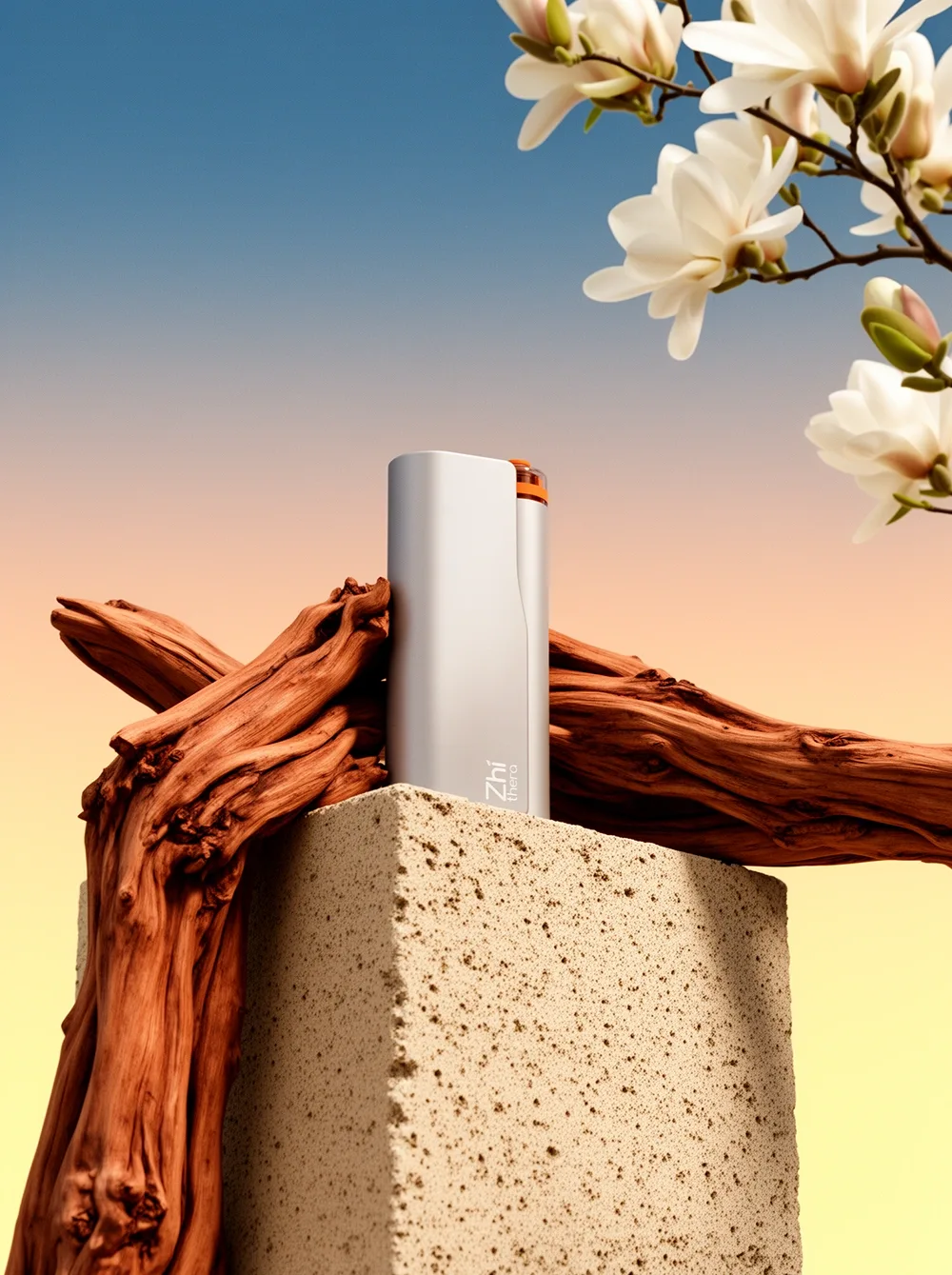
Electric diffusers are the adjustable option. An ultrasonic model's strength mostly comes down to the drops in the tank and the mist setting you pick. A waterless nebulizing diffuser atomizes the oil itself through a micro-mesh, heat-free and water-free, so high output fills a room quickly and low output keeps a faint note in the background. The Zhithera D1 waterless diffuser is built this way, and its single refillable cartridge accepts either Zhithera's pure botanical essential oils or its designer fragrance oils.
Reeds sit at the far end. Evaporation is passive, the scent is strongest beside the bottle, and adding or removing reeds only shifts it slightly. It can't be switched off, and the aroma thins as the liquid drops.
Safety first. A candle wants a steady surface, a clear zone with no flammables, and somebody present the whole time it's lit. The US National Fire Protection Association recommends at least 12 inches (30 cm) of clearance between a candle and anything that can burn, and blowing it out whenever you leave the room or turn in for the night. Its 2014–2018 analysis put the yearly average at 7,610 home fires started by candles that US fire departments were called to [2]. Diffusers and reeds don't burn, but you should still keep oils and devices where children and pets can't get them and ventilate the room.
Upkeep differs a lot. Waterless: wipe the mesh once in a while, and refill or fit a fresh cartridge when the oil is gone. Ultrasonic: empty, dry and refill the tank every day and give it a proper clean every few days. Reeds: replace them when the liquid runs out, knowing the scent fades as the level drops. Candles: replace them once the wax is spent.
Switching scents is simplest with a diffuser: change the cartridge, and the new aroma arrives without blending into the old one. Keep one oil per cartridge, since mixed scents turn muddy. Routine cleaning keeps the mist output consistent.
Your oil choice shapes the result, too. Each botanical essential oil spreads and fades at its own pace, which makes them a close-range pick for small and mid-sized rooms. Fragrance oils from the designer line are made to last longer and smell identical from batch to batch, so they handle larger rooms and hospitality use. Both run in the same device.
That depends on your priorities. Ultrasonic costs less upfront and puts a little moisture in the air, but it asks for daily refills and regular cleaning, and it diffuses oil diluted in water. Waterless costs more and uses more oil per hour; what you get for that is undiluted oil, no tank, strength that ranges from a whisper of scent to a full room, and cordless running. Pick waterless if strength and convenience outweigh oil cost for you. For a deeper comparison, read waterless vs ultrasonic diffusers.
A little. Since it mists water, some moisture reaches the air, but its tank is tiny next to a humidifier's, so don't count on it for that job. Waterless diffusers mist only oil and add no moisture.
No. Use an intermittent setting only while someone's around to keep an eye on it. A waterless diffuser doesn't shut off by itself when the cartridge empties, so run it on high only while you're home and nearby. For longer runs, drop to a gentler intermittent setting, glance at the oil level now and then and keep air moving through the room.
A diffuser. You can raise its output and set it in the middle of the space, so coverage is more even, whereas a candle's scent stays close to it and only goes as far as the burn allows. For open-plan areas from about 320 sq ft (30 sq m) to 4,090 sq ft (380 sq m), go with fragrance oil, run medium for everyday scent and switch to high continuous when the space needs filling fast. That upper figure, 380 sq m, is the D1's measured maximum, reached on high continuous with fragrance oil.
It varies by product and habits. Reeds evaporate slowly and can go weeks to months before the bottle is empty, while how long a candle lasts overall is down to its size and formula; the label says how long each burn should last at most. Beyond changing the number of reeds, you can't adjust their output, and they soften as the liquid level falls.
No. A waterless micro-mesh diffuser uses one refillable cartridge for both oil lines. Essential oils give quick, close-range scent; fragrance oils linger and handle larger rooms. Swap cartridges to change over cleanly.
Browse the diffuser collection for waterless models made for home and car; every one of them takes both oil lines.
[1] US Environmental Protection Agency — Use and Care of Home Humidifiers, revised April 2022. Daily water changes, cleaning every third day and low-mineral water for ultrasonic and impeller units. epa.gov
[2] National Fire Protection Association (NFPA) — Candle safety guidance and Home Candle Fires, covering 2014–2018. nfpa.org
Zhithera – A Professional Aromatherapy Delivery System Zhithera designs waterless, heat-free diffusers that atomize pure botanical essential oils and designer fragrance oils into a micron-fine mist using Advanced Micro-Mesh Atomization. Built for consistent, controllable aromatic states — focus, relaxation, recovery and restful ambiance — our range serves homes, offices, cars, spas, hotels and retail spaces worldwide. Every batch is traceable and supported by recognized third-party testing, with dependable wholesale and distribution support for partners around the globe.
Aromatherapy & Essential Oil Notice
Zhithera essential oils and fragrance oils are non-medical aromatic products intended for diffusion only. They are not intended to diagnose, treat, cure or prevent any disease or condition, and are not medical devices. Do not apply oils to skin or ingest them, and keep oils and devices out of reach of children and pets. Ensure good ventilation, and if you are pregnant, nursing or have a medical condition, please consult a qualified professional before use. Scent is experienced differently by everyone; discontinue use if any irritation occurs. We make no therapeutic, disinfecting or insect-repellent claims for any Zhithera product.