
NEWS & BLOG · October 7, 2026 · By Zhithera Studio
D1 or D1 mini? Three questions decide it: how big the room is, how you want to power it, and how often you swap scents. Both run the same 6.5 ml cartridge and the same waterless ultrasonic micro-mesh atomization; where they part ways is the body, the dock and how output is controlled.
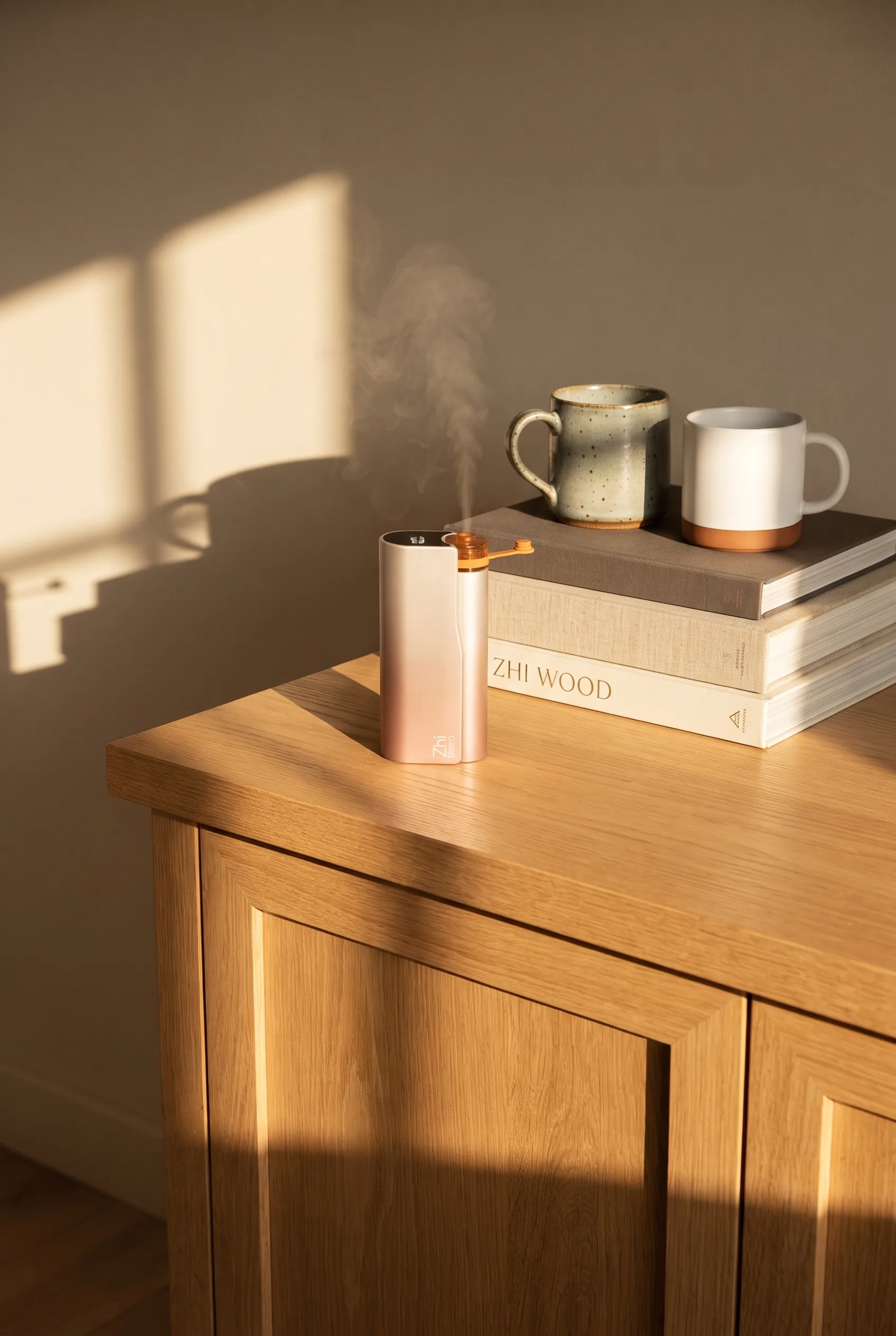
Pick the D1 waterless diffuser if it will live in one spot. Its body is 6-series aircraft aluminum, and it sits on a 3500 mAh power base that runs the diffuser and can also top up a phone in an emergency. Pick the D1 mini diffuser if it will travel: an engineering-plastic body, a magnetic cartridge that swaps in about a second, and a magnetic mount for the car. Inside, both use the same 6.5 ml refillable cartridge and the same heat-free, waterless micro-mesh atomization.
D1 power figures: Type-C 5V/2.4A in, pogo-pin 5V at 0.75A out to the diffuser. While misting it draws about 300 mA (around 1.5 W); on standby, under 50 uA. Charging, the dock pulls about 12 W.
The D1 has three output levels: low, medium and high (continuous). Zhithera rates high continuous at about 4.3 ml an hour; scaled from that, medium is estimated at 0.87 ml an hour and low intermittent at 0.14 ml an hour. So a full 6.5 ml cartridge lasts about 1.5 hours on high continuous; on medium the estimate is 7.5 hours, and on low about 46.5 hours, or roughly two days.
On the D1 mini you get three modes: continuous (mode 1); 15 seconds of mist alternating with a 2-minute pause (mode 2); and a vibration-triggered mode 3 that mists 5 seconds, pauses 2 minutes, and sleeps once 10 minutes pass with no activity. Both models atomize through a micro-porous vibrating mesh, and the refillable cartridges move freely between them.
Room size, setting and oil type work together. Here's how they line up:
Materials first. The D1 combines FVMQ, PP, AL6063 and COC; take away the aluminum and you have the D1 mini, a plastic-bodied unit built from FVMQ, PP and COC. Operating temperature is 5 to 40 °C for the D1 and from −10 to 80 °C for the D1 mini. Both are rated IPX1 and work at 10 to 80% RH, and the hardware is meant for use no higher than 2000 m, outside tropical climates.
Pick the D1 if you want dock power, adjustable output and an aluminum body. Pick the D1 mini if you want something portable that mounts magnetically and senses motion in the car. Both take the same cartridge and run heat-free waterless atomization. After about five refills, check the cartridge and replace it if the mist has weakened; that keeps output consistent.
Pick botanical essential oils for close range. Their composition varies from oil to oil, and so does how fast the aroma spreads and fades, so they're happiest in compact spaces: a reading corner, the car, a study or a bedroom. The botanical essential oils come in 10 ml bottles for this kind of use.
Pick fragrance oils for bigger rooms. Bottled at 100 ml, the designer line includes Eastern Elegant House, Orange Blossom and Sweetheart of Blooming Flowers, all three made with Givaudan fragrance materials. They last longer, smell the same batch after batch, and suit larger rooms and hospitality settings. Choose the fragrance oils where you want scent that lingers. Either oil runs in the same device.
It's built for the car. A magnetic in-car mount holds it, and mode 3 senses motion: vibration wakes it, it mists 5 seconds, pauses 2 minutes, and goes to sleep after 10 minutes with no activity. It shares the D1's 6.5 ml cartridge and its waterless micro-mesh too.
On the D1's low intermittent setting, use is estimated at about 0.14 ml an hour, which puts a full 6.5 ml cartridge at an estimated 46.5 hours, about two days of intermittent running. Expect the real figure to shift with the setting you use, the room and how thick the oil is.
Yes. One 6.5 ml refillable cartridge design serves both the D1 and the D1 mini, and it swaps magnetically. Being consumables, cartridges and their mesh are judged differently: wear from normal use, or verified misuse, is assessed apart from product-quality concerns. The warranty terms attached to your order and sales channel spell out the rest.
About 380 square meters, or roughly 4,090 sq ft. That figure was measured on high continuous with fragrance oil. In a real room, ceilings, airflow, partitions and open windows all play a part.
Inside the dock is a 3500 mAh battery; power reaches the diffuser over pogo pins at 5V/0.75A. It charges over Type-C at 5V/2.4A. It pulls around 300 mA while misting and less than 50 uA on standby.
Still deciding? Both models sit side by side in the Diffusers collection.
Zhithera – A Professional Aromatherapy Delivery System Zhithera designs waterless, heat-free diffusers that atomize pure botanical essential oils and designer fragrance oils into a micron-fine mist using Advanced Micro-Mesh Atomization. Built for consistent, controllable aromatic states — focus, relaxation, recovery and restful ambiance — our range serves homes, offices, cars, spas, hotels and retail spaces worldwide. Every batch is traceable and supported by recognized third-party testing, with dependable wholesale and distribution support for partners around the globe.
Aromatherapy & Essential Oil Notice
Zhithera essential oils and fragrance oils are non-medical aromatic products intended for diffusion only. They are not intended to diagnose, treat, cure or prevent any disease or condition, and are not medical devices. Do not apply oils to skin or ingest them, and keep oils and devices out of reach of children and pets. Ensure good ventilation, and if you are pregnant, nursing or have a medical condition, please consult a qualified professional before use. Scent is experienced differently by everyone; discontinue use if any irritation occurs. We make no therapeutic, disinfecting or insect-repellent claims for any Zhithera product.